
Sealing Stone Countertops: How Often, Why, and What to Use
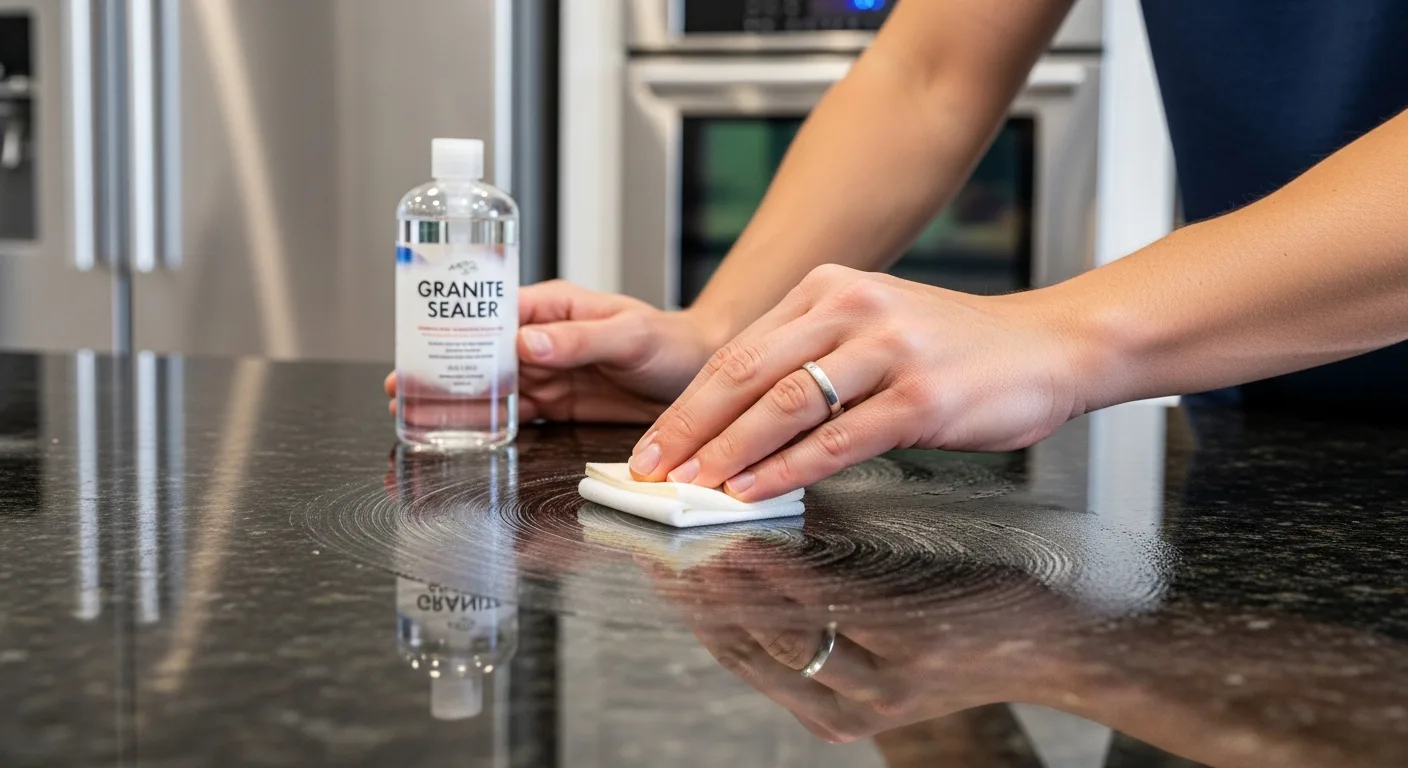
Image is illustrative.
Most natural stone countertops need sealing every one to two years to prevent staining and moisture damage. Marble is the exception and needs sealing every six to twelve months. If you live in Las Vegas, our 278 ppm hard water means mineral deposits build up faster on unsealed stone, so staying on schedule matters more here than almost anywhere else in the country.
At Night & Day Stone, we seal every natural stone countertop at installation. When it's time to re-seal down the road, our sister company Night and Day Stone Restoration handles it. We've been working with stone in Las Vegas for over 20 years, and sealing questions are the number one maintenance topic homeowners ask us about.
Key Takeaways
- Granite and Quartzite need sealing every 1-2 years; Marble needs sealing every 6-12 months
- Quartz and Porcelain are non-porous and never need sealing
- Las Vegas hard water (278 ppm) accelerates mineral buildup on unsealed stone, making timely re-sealing critical
- The water drop test takes 30 seconds and tells you exactly when your countertops need re-sealing
- Night & Day Stone seals at installation and our sister restoration company handles re-sealing: call (702) 809-8436
What Does Sealing Actually Do?
Natural stone is porous. Even the hardest Granite has microscopic pores in its surface that you can't see or feel. Those pores do three things you don't want: they absorb liquids that cause stains, they trap moisture that can lead to discoloration, and they give bacteria a place to hide.
A sealer fills those microscopic pores with a protective compound. Think of it like sunscreen for your stone. The sealer doesn't change the look or feel of your countertops. It sits below the surface and creates a barrier that slows down liquid absorption long enough for you to wipe up spills before they become permanent stains.
Without sealing, a splash of red wine on Granite could penetrate the surface in minutes. With proper sealing, that same splash sits on top of the stone and wipes away clean. In Las Vegas, sealing also helps prevent hard water mineral deposits from bonding with the stone's pores, which makes those white chalky rings much easier to clean.
Which Materials Need Sealing (and Which Don't)
Not every countertop material needs sealing. Here's a clear breakdown.
Materials That Need Sealing
Granite is dense and durable, but it's still a natural stone with pores. Most Granite countertops need sealing every one to two years. Lighter-colored Granites like White Ice and Alaska White tend to be more porous than darker varieties like Absolute Black, so they may need sealing more frequently.
Marble is softer and more porous than Granite. Marble countertops need sealing every six to twelve months, depending on use. Kitchens with heavy daily use lean toward every six months. Bathroom vanities with lighter use can stretch closer to twelve months.
Quartzite is harder than Granite (7 on the Mohs scale), but it still has natural pores. Quartzite countertops need sealing every one to two years. The good news is that Quartzite's density means it absorbs liquids more slowly than Marble, giving you more time to wipe up spills.
Materials That Don't Need Sealing
Quartz (engineered stone) is non-porous by design. The manufacturing process binds crushed quartz with resin, creating a surface with zero pores. Sealing Quartz countertops is unnecessary and can actually leave a hazy film on the surface. If a fabricator or salesperson tells you to seal your Quartz, that's a red flag.
Porcelain slabs are fired at extremely high temperatures, making them completely non-porous. No sealing needed, ever.
Soapstone doesn't need sealing either, but it does need regular oiling with mineral oil to maintain an even color and develop its characteristic patina. Oiling is a different process than sealing.
Sealing Schedule by Material
| Material | Sealing Frequency | Las Vegas Adjustment | Notes |
|---|---|---|---|
| Granite (light colors) | Every 1-2 years | Every 12-18 months | More porous, hard water builds up faster |
| Granite (dark colors) | Every 2-3 years | Every 18-24 months | Denser, less porous |
| Marble | Every 6-12 months | Every 6 months | High porosity, very reactive to hard water |
| Quartzite | Every 1-2 years | Every 12-18 months | Dense but still porous |
| Quartz (engineered) | Never | Never | Non-porous, sealing causes haze |
| Porcelain | Never | Never | Non-porous |
| Soapstone | Never (oil instead) | Never (oil instead) | Monthly mineral oil application |
Las Vegas homeowners should lean toward the shorter end of every range. Our hard water at 278 parts per million leaves mineral deposits on stone surfaces faster than most cities. When sealer breaks down and those pores open up, hard water gets in and creates stubborn white mineral rings that are much harder to remove than a simple food stain.
The Water Drop Test: How to Tell If Your Countertops Need Re-Sealing
This is the simplest test in all of countertop care, and it takes 30 seconds.
- Pour a small amount of water (about a tablespoon) on your countertop surface
- Let it sit for 10 to 15 minutes
- Wipe the water away and look at the spot
If the area looks darker where the water sat, the stone absorbed moisture. Your sealer has worn through and it's time to re-seal.
If the water beaded up and the surface looks the same after wiping, your sealer is still working. Check again in a few months.
Run this test in a few different areas, especially near the sink and stove where water contact and cleaning happen most often. Those high-use zones lose their sealer faster than a section of countertop near the wall that rarely gets touched.
We recommend running the water drop test every three to four months. It takes almost no effort and saves you from discovering your sealer failed when red pasta sauce hits the counter.
Types of Sealers: Impregnating vs. Topical
There are two main categories of countertop sealers, and one is dramatically better for kitchen and bathroom use.
Impregnating Sealers (Recommended)
Impregnating sealers penetrate below the stone surface and fill the pores from the inside. They don't change the appearance of the stone. They don't create a coating. They don't make the surface slippery. The stone still looks and feels exactly the same, but liquids can't penetrate.
This is what we use at Night & Day Stone for every installation, and it's what we recommend for re-sealing. Impregnating sealers last longer, perform better, and don't peel or flake.
Topical Sealers (Not Recommended for Countertops)
Topical sealers sit on top of the stone surface like a coat of paint. They can change the appearance (making it look wet or glossy), they wear unevenly with use, and they can peel, scratch, or create a hazy buildup over time. Topical sealers are better suited for stone floors or outdoor pavers where appearance change is acceptable.
For countertops, stick with an impregnating sealer. Look for products from brands like Tenax, StoneTech, or Dry-Treat that are specifically formulated for natural stone countertops.
How to Seal Your Countertops: DIY Step by Step
Sealing countertops is one of the few stone maintenance tasks that most homeowners can handle themselves. Here's the process we recommend.
What You'll Need
- Impregnating stone sealer (not topical)
- Clean microfiber cloths (at least 3)
- Isopropyl alcohol or stone-safe cleaner
- Painter's tape (optional, for protecting walls)
Step-by-Step Process
Step 1: Clean the surface thoroughly. Remove everything from the countertops. Clean the entire surface with isopropyl alcohol or a pH-neutral stone cleaner. Don't use vinegar, bleach, or all-purpose cleaners. You need the stone completely clean and dry before sealing.
Step 2: Let the surface dry completely. Wait at least 30 minutes after cleaning. The stone needs to be bone dry. Any moisture trapped under the sealer will cloud the stone.
Step 3: Apply the sealer. Pour a small amount of sealer onto the surface and spread it evenly with a clean microfiber cloth. Work in sections of about four square feet at a time. Apply a thin, even coat. More is not better with sealer.
Step 4: Let it absorb. Follow the manufacturer's recommended absorption time, usually 15 to 20 minutes. The sealer needs time to penetrate the pores. You'll see it soak in and the surface will start to look dry.
Step 5: Wipe off the excess. Using a clean, dry microfiber cloth, buff away any remaining sealer from the surface. This step is critical. Sealer left sitting on top of the stone will dry as a hazy, sticky residue that's difficult to remove.
Step 6: Apply a second coat (optional). For highly porous stones like Marble or light-colored Granite, a second coat improves protection. Wait 30 minutes between coats.
Step 7: Let it cure. Most impregnating sealers need 24 hours to fully cure. During this time, avoid placing anything on the countertops and don't let water contact the surface. Plan your sealing project for a day when you can leave the kitchen alone.
Common Sealing Mistakes
We've been restoring and maintaining stone in Las Vegas for over 20 years. Here are the mistakes we see most often.
Using the wrong product. All-purpose sealers, floor sealers, and topical coatings are not the same as a countertop-grade impregnating sealer. Using the wrong product can leave haze, change your stone's appearance, or provide almost no protection.
Not giving enough cure time. Twenty-four hours feels like a long time to stay off your kitchen countertops. We get it. But setting a coffee mug on freshly sealed stone after four hours can leave a ring that takes professional intervention to remove. Wait the full cure time.
Sealing Quartz countertops. This is the most common unnecessary mistake we see. Quartz is engineered to be non-porous. It does not need sealing. Applying sealer to Quartz creates a sticky, hazy film that actually makes the surface harder to clean. If you have Quartz, save your money and skip the sealer entirely.
Skipping the cleaning step. Sealing over a dirty surface traps grime, oils, and residue under the sealer. This can cause discoloration and makes the sealer less effective. Always start with a perfectly clean, dry surface.
Over-applying. A thick coat of sealer doesn't provide more protection. It just creates more excess that you'll need to buff off, and any leftover residue will dry as a haze. Thin, even coats are all you need.
Professional Sealing vs. DIY: When to Call a Pro
For routine re-sealing on a countertop that's in good condition, DIY works well. The process is straightforward, and a quality impregnating sealer from a home improvement store will do the job.
Call a professional when:
- Your stone has existing stains. Sealing over a stain locks it in. A restoration professional can poultice and remove stains before re-sealing.
- You see etching or dull spots on Marble. Etching is a chemical reaction, not a stain. It needs honing or polishing before sealing, which requires professional equipment.
- Hard water damage is severe. Heavy mineral buildup in Las Vegas kitchens sometimes needs professional removal before re-sealing. Our sister company Night and Day Stone Restoration handles this regularly.
- You're not confident in the process. There's no shame in calling a pro. A bad sealing job can create problems that cost more to fix than the professional sealing would have cost in the first place.
Last year, a homeowner in Summerlin called us after sealing her Calacatta Marble kitchen island with a topical sealer she'd found at a hardware store. The sealer left a cloudy, uneven film across the entire surface that dulled the veining she'd fallen in love with. Our restoration team spent two hours stripping the old sealer, honing the surface, and re-sealing with an impregnating product. The island looked beautiful again, but she spent more fixing the problem than a professional sealing would have cost.
A Henderson couple had the opposite experience. They'd been re-sealing their Granite countertops themselves for six years using the impregnating sealer we recommended at installation. Every year they did the water drop test, cleaned the surface, applied the sealer, and went about their lives. When we saw their kitchen during a backsplash project last spring, the Granite looked as good as the day we installed it. DIY sealing absolutely works when you use the right product and follow the steps.
Not sure whether your countertops need professional attention or just a re-seal? Call us at (702) 809-8436 and describe what you're seeing. We'll tell you honestly whether it's a DIY job or something our restoration team should handle.
Frequently Asked Questions
How often should I seal my Granite countertops?
Most Granite countertops need sealing every one to two years. In Las Vegas, we recommend leaning toward every 12 to 18 months due to our hard water at 278 ppm. Use the water drop test every few months to check whether your sealer is still performing.
Do Quartz countertops need sealing?
No. Quartz is engineered stone made from crushed quartz bound with resin, making it completely non-porous. Sealing Quartz is unnecessary and can leave a hazy film on the surface. If your countertops are Quartz, skip the sealer and simply clean with mild soap and water.
What is the best sealer for kitchen countertops?
An impregnating (also called penetrating) sealer is the best choice for kitchen countertops. It absorbs into the stone without changing the appearance or feel. Brands like Tenax, StoneTech, and Dry-Treat make high-quality countertop-specific impregnating sealers. Avoid topical sealers, which sit on the surface and can peel or haze.
Can I seal my countertops myself?
Yes. Re-sealing is a straightforward DIY project for countertops in good condition. Clean the surface, apply a thin coat of impregnating sealer, let it absorb, wipe off the excess, and allow 24 hours of cure time. If your stone has stains, etching, or hard water damage, have a professional address those issues before you re-seal.
How do I know if my countertops need re-sealing?
The water drop test is the most reliable method. Place a tablespoon of water on the countertop and wait 10 to 15 minutes. If the stone beneath the water looks darker after you wipe it away, moisture penetrated the surface and it's time to re-seal. If the water beads up and the stone looks unchanged, your sealer is still working.
Does Night & Day Stone seal countertops at installation?
Yes. We professionally seal every natural stone countertop (Granite, Marble, Quartzite) at the time of installation. Your countertops are protected from day one. When it's time to re-seal, our sister company Night and Day Stone Restoration provides professional re-sealing and restoration services for Las Vegas homeowners.
Keep Your Stone Beautiful for Decades
Sealing countertops is the single most important maintenance step for natural stone. It takes an afternoon every year or two, and it protects an investment that should last decades. Stay on top of your sealing schedule, run the water drop test regularly, and use the right product.
If you're planning a new countertop project, we seal at installation so you're protected from day one. If your existing countertops need re-sealing or restoration, our sister company has been caring for Las Vegas stone since before we started fabricating it.
Call (702) 809-8436 to schedule a free countertop estimate or ask about re-sealing services. We're available 7 days a week, 7 AM to 8 PM.
Request Your Free Estimate | Call (702) 809-8436
Ready to Get Started?
Call us for a free estimate. Visit our slab yard and hand-pick your exact stone.