
Quartz vs Quartzite: They Sound Similar but They're Very Different
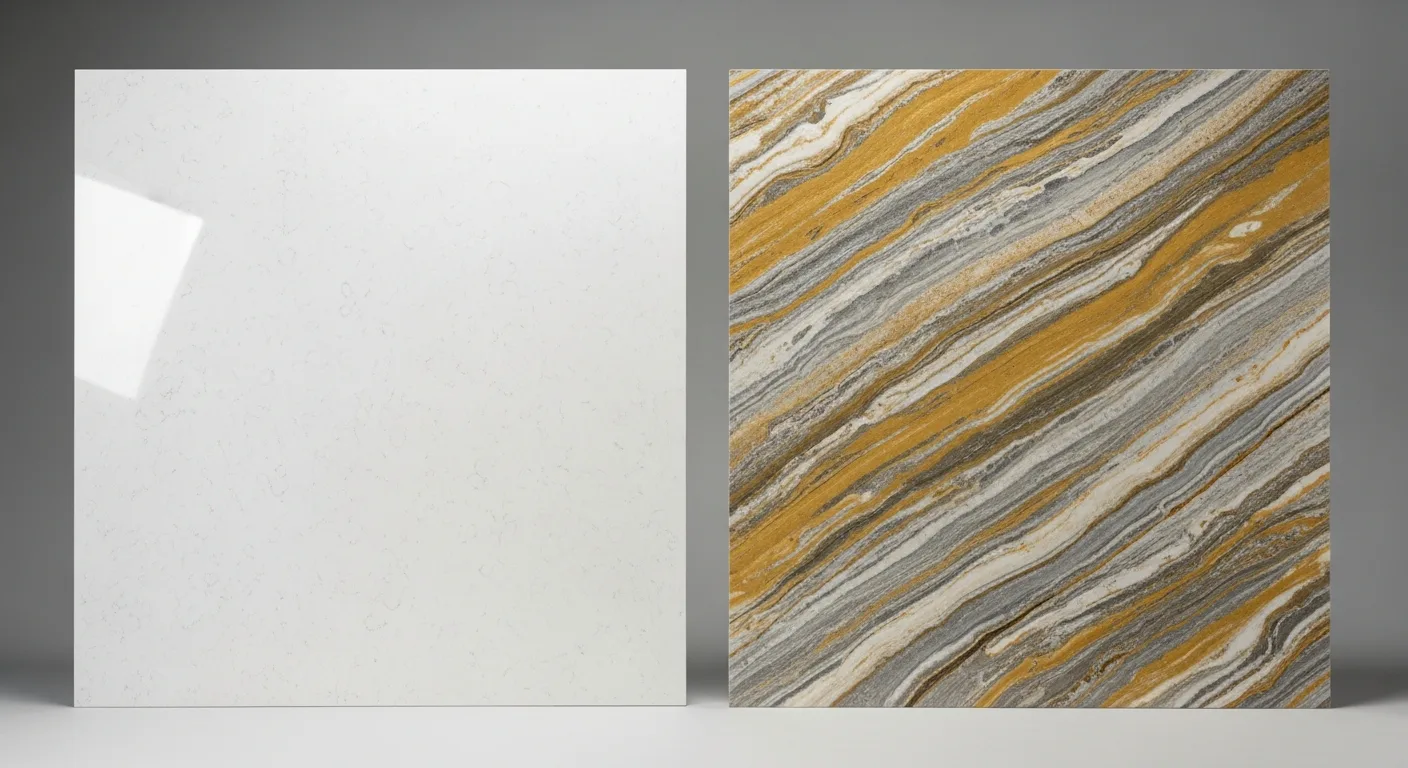
Image is illustrative.
They're one letter apart. They sit next to each other in showrooms. Retailers sometimes mislabel them. And homeowners mix them up constantly. But Quartz and Quartzite are completely different materials with different origins, different properties, and different maintenance needs.
Here's the fundamental difference: Quartz is an engineered countertop made from crushed quartz crystals bound together with resin. Quartzite is a natural metamorphic stone quarried from the earth. One comes from a factory. The other comes from a mountain.
That single distinction changes everything about how these materials perform in your kitchen. We've spent 20+ years fabricating and installing both materials across Las Vegas — from engineered Quartz to authentic quartzite countertops in Las Vegas — and we can tell you that choosing the wrong one based on a name mix-up leads to frustration. This guide makes sure that doesn't happen to you.
Quartz vs Quartzite Installed Cost at a Glance
| Material | Installed Cost (Per Sq Ft) | 30 Sq Ft Kitchen | 50 Sq Ft Kitchen |
|---|---|---|---|
| Quartz (engineered) | $50 - $120 | $1,500 - $3,600 | $2,500 - $6,000 |
| Quartzite (natural) | $60 - $150 | $1,800 - $4,500 | $3,000 - $7,500 |
Both prices include digital templating, CNC fabrication, a standard edge profile, and installation. Want to run your own numbers? Compare both materials side by side with our countertop material comparison calculator.
Key Takeaways
- Quartz is engineered (crushed stone + resin). Quartzite is natural metamorphic rock. They are completely different materials.
- Quartz requires zero maintenance and is non-porous. Quartzite needs sealing every 6 to 12 months.
- Quartzite handles heat and UV exposure better than Quartz, making it safer for sun-facing Las Vegas kitchens.
- Quartz offers consistent colors and patterns. Quartzite offers unique natural veining similar to Marble.
- Installed cost overlaps significantly: $50 to $120 per square foot for Quartz vs $60 to $150 for Quartzite.
The Fundamental Difference: Engineered vs Natural
Understanding where each material comes from clears up every other question about performance and maintenance.
Quartz (Engineered Stone)
Quartz countertops are manufactured in a factory. Producers take roughly 90-93% ground natural quartz crystals and mix them with 7-10% polymer resins and pigments. This mixture is compressed under extreme pressure, cured, and polished into slabs. Major brands include Caesarstone, Cambria, Silestone, and MSI.
Because humans control the manufacturing process, Quartz slabs have consistent colors and patterns. You can order multiple slabs that look identical. The resin binding creates a non-porous surface that never needs sealing.
Quartzite (Natural Stone)
Quartzite forms when sandstone is subjected to extreme heat and pressure deep within the earth over millions of years. The sand grains recrystallize into an interlocking mosaic of quartz crystals, creating one of the hardest natural stones available. Each slab is unique, with flowing veins and translucent depth that no engineered product can replicate.
Quartzite is quarried in blocks, then cut and polished into slabs. Popular varieties include Taj Mahal, Super White, Fantasy Brown, and Sea Pearl. Because it's natural stone, every slab has unique movement, veining, and color variation.
Why the Confusion Exists
The confusion is partly geological (both contain quartz mineral) and partly commercial. Some retailers use "Quartzite" loosely, and some stones sold as Quartzite are actually Dolomite or soft Marble that won't perform like true Quartzite. More on that in the misconceptions section below.
Side-by-Side Comparison
| Feature | Quartz (Engineered) | Quartzite (Natural) |
|---|---|---|
| Composition | 90-93% crushed quartz + resin | 100% natural metamorphic stone |
| Hardness | 7 Mohs | 7-8 Mohs |
| Porosity | Non-porous | Porous (requires sealing) |
| Maintenance | None | Seal every 6-12 months |
| Heat Resistance | Poor (resin can scorch) | Excellent (formed under heat) |
| UV Resistance | Poor (can yellow) | Excellent (UV-safe) |
| Appearance | Consistent, manufactured patterns | Unique natural veining |
| Cost (Installed) | $50 - $120/sqft | $60 - $150/sqft |
| Best For | Low-maintenance indoor kitchens | Sun-facing rooms, natural stone lovers |
Durability and Hardness
Both Quartz and Quartzite are hard, durable surfaces that will last decades in a kitchen. But they achieve that hardness differently, and Quartzite has a slight natural advantage.
Quartzite scores 7-8 on the Mohs hardness scale, making it one of the hardest natural countertop materials available. It's harder than Granite. You can chop directly on Quartzite without scratching it (though we still recommend cutting boards to protect your knives). It resists chipping, etching from acids, and everyday wear.
Quartz scores around 7 on the Mohs scale due to its engineered quartz crystal content. It's also extremely scratch-resistant and handles daily kitchen abuse without showing wear. The resin component makes it slightly more flexible than natural stone, meaning it's less prone to cracking during transport and installation.
In everyday kitchen use, both materials perform beautifully. You'd be hard-pressed to damage either one through normal cooking and meal preparation.
Winner: Slight edge to Quartzite. It's naturally harder and won't scratch from any kitchen activity. But practically speaking, both are more than durable enough for any home kitchen.
Maintenance and Care
This is the category where these two materials diverge most dramatically, and it's often the deciding factor for homeowners.
Quartz: True Zero Maintenance
Quartz is non-porous. The resin binder seals the crushed quartz crystals into a surface that nothing can penetrate. Wine, oil, coffee, tomato sauce, and Las Vegas hard water all sit on top and wipe away with soap and water. No sealing. No special cleaners. No annual maintenance appointments.
For busy Las Vegas households dealing with 278 ppm hard water, this matters. Water spots wipe right off a Quartz surface. There is nothing to stain, nothing to etch, and nothing to worry about.
Quartzite: Low but Not Zero
Quartzite is a natural stone, which means it has microscopic pores. It needs professional sealing at installation and resealing every 6 to 12 months depending on use and the specific stone variety. Without proper sealing, liquids can penetrate and cause staining.
That said, Quartzite is significantly less porous than Marble or even most Granite. A quality sealer protects it effectively, and the resealing process takes about 15 minutes. Our sister company, Night and Day Stone Restoration, handles resealing for homeowners who prefer professional maintenance.
Winner: Quartz. If you want a surface you literally never have to think about maintaining, Quartz is the clear choice. If you don't mind a simple sealing schedule, Quartzite's maintenance is very manageable.
When Maria renovated her kitchen in Henderson last spring, she initially wanted Quartzite for its natural beauty. But with three kids, a home bakery business, and flour constantly dusting every surface, she was concerned about the sealing commitment. We walked her through both options at our slab yard. She chose Quartz with a dramatic veined pattern that gave her the natural stone look she loved with the zero-maintenance performance her lifestyle demanded. Six months later, she told us it was the best decision she made during the entire remodel.
Appearance and Aesthetics
This is where Quartzite often wins hearts, even from people who logically prefer Quartz's low maintenance.
Quartzite: Natural Art
Quartzite slabs have a depth, translucency, and movement that engineered products cannot replicate. Light passes through the crystalline structure, creating an almost three-dimensional quality. The veining and color flow happened over geological time scales, and every slab tells a different story.
Varieties like Taj Mahal offer warm golds and soft veining. Super White delivers a Marble-like aesthetic with dramatically better durability. Sea Pearl combines grays, greens, and silvers in flowing patterns. When you visit our slab yard and see Quartzite in person, the natural beauty is immediately apparent.
Quartz: Controlled Consistency
Quartz manufacturers have become remarkably skilled at creating beautiful surfaces. Modern Quartz slabs can mimic the look of Marble, Quartzite, and Granite with increasing realism. They offer solid colors, subtle veining, bold patterns, and everything in between.
The key advantage is consistency. If you need a 12-foot island to match your perimeter countertops exactly, Quartz delivers that uniformity. You can order from the same lot and get virtually identical slabs. With Quartzite, every slab is different, which means seams and adjacent pieces will have natural variation.
No clear winner. If you value natural uniqueness and depth, Quartzite wins. If you value consistency and controlled design, Quartz wins. Both look stunning in a finished kitchen.
Heat Resistance
This is a critical performance difference, especially for serious home cooks.
Quartzite formed under extreme geological heat and pressure. You can set a hot pan directly on a Quartzite countertop without any risk of damage. It will not scorch, discolor, or crack from kitchen heat sources. It's as heat-safe as Granite or Marble.
Quartz contains polymer resins that bind the crushed stone together. Those resins can scorch, discolor, or even crack when exposed to sustained direct heat. A hot pan straight from the stove or oven can leave a permanent white ring or brown mark on a Quartz surface. Always use trivets and hot pads with Quartz countertops.
Winner: Quartzite. It handles heat without any concern. If you cook frequently, use cast iron, or regularly pull hot pots off the stove, Quartzite's heat resistance is a significant advantage.
We had a client last year who had just replaced his Quartz countertops after only four years because of heat damage. He cooked professionally at home and routinely set hot pans on his countertops despite the warnings. After seeing the scorch marks multiply, he came to us for Quartzite. We fabricated Taj Mahal Quartzite for his kitchen, and he told us it was liberating to cook without worrying about where he put a hot pan.
Ready to compare these materials in person? Visit our slab yard and see Quartz and Quartzite side by side. Call (702) 809-8436 to schedule a visit, or request a free estimate.
Cost Comparison
Both materials overlap in price, though Quartzite generally runs slightly higher at comparable quality levels.
| Material | Cost Per Sq Ft (Installed) | 30 Sq Ft Kitchen | 50 Sq Ft Kitchen |
|---|---|---|---|
| Quartz | $50 - $120 | $1,500 - $3,600 | $2,500 - $6,000 |
| Quartzite | $60 - $150 | $1,800 - $4,500 | $3,000 - $7,500 |
Entry-level Quartz starts around $50 per square foot installed, while Quartzite typically starts around $60. At the premium tier, exotic Quartzite slabs with dramatic movement can reach $150 per square foot, higher than most premium Quartz options.
These prices include digital templating, CNC fabrication, a standard edge profile (eased or beveled), and installation. Sink cutouts ($150-$300), upgraded edge profiles ($10-$30 per linear foot), old countertop removal ($200-$500), and initial sealing for Quartzite are quoted separately.
The long-term cost difference is minimal. Quartz saves you sealing costs (about $100-$200 per resealing visit). Quartzite adds that ongoing expense. Over 20 years, the maintenance cost difference is roughly $2,000 to $4,000 depending on your stone and how frequently you seal.
The Las Vegas Verdict
Las Vegas climate creates specific performance considerations for both materials that you won't find in generic comparison guides.
Quartz in Las Vegas: Hard Water Champion, UV Risk
Quartz's non-porous surface is perfectly suited to Las Vegas hard water at 278 ppm. Mineral deposits, water spots, and everyday kitchen messes wipe away without penetrating the surface. For homeowners tired of fighting hard water stains, Quartz eliminates that battle entirely.
The risk: Las Vegas sun. Quartz contains resin binders that yellow with prolonged UV exposure. If your kitchen has large west-facing windows that flood the countertops with afternoon desert sun — common in Summerlin homes built to capture mountain views — Quartz surfaces may discolor over time. Window treatments, UV-filtering glass, or simply positioning Quartz away from direct sunlight mitigates this concern.
Quartz should never be used for outdoor kitchen countertops in Las Vegas. The combination of direct UV and extreme heat will damage engineered stone.
Quartzite in Las Vegas: UV Safe, Sealing Essential
Quartzite is completely UV-safe. It will not yellow, fade, or degrade from any amount of Las Vegas sun exposure. If your kitchen faces west with floor-to-ceiling windows, Quartzite handles that environment without concern. It's also suitable for covered outdoor applications where UV exposure is present.
The trade-off: Las Vegas hard water at 278 ppm builds mineral deposits faster on porous natural stone. Quartzite must be sealed consistently, and in our local water conditions, we recommend staying on the shorter end of the sealing schedule (every 6 months for heavy-use kitchens). Skip a sealing and hard water minerals can work their way into the stone's pores.
Choose Quartz If...
- You want absolutely zero maintenance, no sealing, no special care
- Las Vegas hard water frustrates you and you want a surface that ignores it
- You prefer consistent colors and patterns across your countertops
- Your kitchen does not get prolonged direct sunlight through west-facing windows
- You have a busy household and want a completely worry-free surface
- You love modern, designer-curated colors and finishes
- Budget is a primary concern and you want the lower entry price point
Choose Quartzite If...
- You love the look of natural stone with unique veining and depth
- Your kitchen faces west and gets direct Las Vegas sun
- You're a serious cook who wants to set hot pans down without worry
- You appreciate knowing your countertop is a one-of-a-kind natural slab
- You don't mind a simple sealing schedule every 6 to 12 months
- You want a material that could work in a covered outdoor application
- You're willing to invest more for rare, exotic natural stone beauty
Common Misconceptions
"Quartzite is just a type of Quartz"
Wrong. Quartzite is natural metamorphic rock. Quartz is a factory-made engineered product. They both contain the mineral quartz, but so does sand. The materials have completely different properties, maintenance requirements, and price points.
"This slab is Quartzite" (but it's actually Dolomite)
This is a real problem in the industry. Some stones marketed as "soft Quartzite" or "Quartzite" are actually Dolomite or Dolomitic Marble. These softer stones etch from acids (lemon juice, vinegar) and scratch more easily than true Quartzite. True Quartzite will not etch from acid contact. If a retailer's "Quartzite" etches when you apply lemon juice, it's not actually Quartzite.
At our slab yard, we verify the geological classification of every stone we sell. When you purchase quartzite countertops in Las Vegas from us, you're getting authentic metamorphic Quartzite that performs as advertised.
"Quartz is natural because it contains natural quartz"
Technically, Quartz countertops do contain natural quartz crystals. But the product itself is manufactured. Calling Quartz "natural" is like calling particleboard "natural wood." The raw ingredient is natural, but the finished product is engineered. If you want a natural stone countertop, you want Quartzite, Granite, or Marble.
"Quartzite doesn't need sealing because it's so hard"
Hardness and porosity are different properties. Quartzite is extremely hard (scratch-resistant) but still has microscopic pores that can absorb liquids. It absolutely requires sealing. Don't let anyone tell you otherwise.
Frequently Asked Questions
Is Quartzite more expensive than Quartz?
Generally yes, though there's significant overlap. Quartz ranges from $50 to $120 per square foot installed, while Quartzite ranges from $60 to $150. At mid-range price points, you can find excellent options in both materials. Exotic Quartzite slabs are typically the most expensive option between the two.
Can you put hot pans on Quartzite?
Yes. Quartzite is formed under extreme geological heat and handles direct contact with hot pans, baking sheets, and pots without damage. This is one of its key advantages over Quartz, which can scorch from heat contact.
Does Quartzite stain?
Quartzite can stain if not properly sealed. With consistent sealing every 6 to 12 months, it resists stains effectively. True Quartzite is also resistant to acid etching, unlike Marble or stones mislabeled as Quartzite.
Which is better for a kitchen with lots of natural light?
Quartzite. It's completely UV-safe and will not yellow or discolor from sun exposure. Quartz contains resin binders that can yellow with prolonged UV exposure, making it a concern for sun-drenched Las Vegas kitchens with west-facing windows.
Can I use Quartz or Quartzite outdoors?
Quartzite can work in covered outdoor applications where some UV and weather exposure occurs. Quartz should never be used outdoors. The combination of direct UV and extreme Las Vegas heat degrades the resin binders in engineered stone.
How do I know if my "Quartzite" is really Quartzite?
Apply a small amount of lemon juice to an inconspicuous area. True Quartzite will not react or etch. If the surface dulls or etches, you likely have Dolomite or Marble that was mislabeled. We test and verify every slab at our shop so you know exactly what you're getting.
See Both Materials at Our Slab Yard
The best way to understand the difference between Quartz and Quartzite is to stand in front of both materials and see them side by side. Photos don't capture the depth and translucency of natural Quartzite, and they don't show you the consistent uniformity that makes Quartz appealing.
Visit our slab yard and we'll show you both materials at every price point. We'll talk about your kitchen layout, your cooking habits, your sun exposure, and your maintenance preferences. Then we'll help you narrow down the choice that fits your home and your lifestyle.
We're a family-owned countertop fabrication shop with 20+ years of stone expertise in Las Vegas. Whether you choose Quartz countertops, Quartzite countertops, or want to explore all your options for your kitchen, we handle every step from slab selection to installation.
Call (702) 809-8436 to schedule your slab yard visit, or request a free estimate online. We're available 7 days a week, 7 AM to 8 PM. No pressure, no hidden fees, just honest guidance from people who work with stone every day.
Ready to Get Started?
Call us for a free estimate. Visit our slab yard and hand-pick your exact stone.