
Granite vs Quartz Countertops: Which Is Better for Las Vegas?
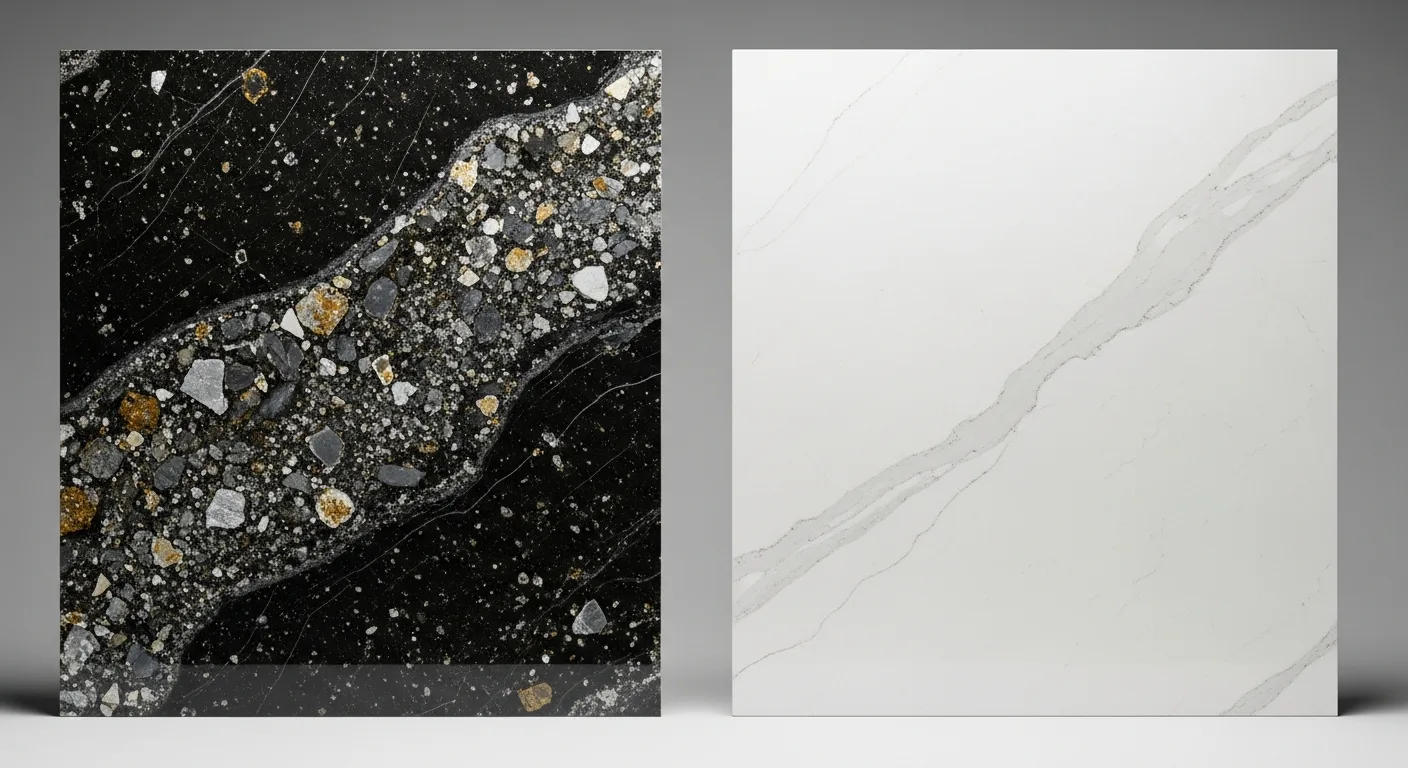
Image is illustrative.
If you're remodeling a kitchen in Las Vegas, you've probably narrowed your countertop search down to two materials: Granite and Quartz. They're the two most popular choices we fabricate and install, and for good reason. Both are durable, beautiful, and add real value to your home.
But they're fundamentally different materials. Granite is natural stone, quarried from the earth with unique mineral patterns in every slab. Quartz is engineered stone, made from crushed quartz crystals bound with resin and pigment. That difference affects everything from how they handle heat to how much maintenance they need.
Here's the short answer: Granite wins on heat resistance and natural beauty. Quartz wins on zero maintenance and consistent color. For Las Vegas specifically, both perform well, but each has a climate consideration you need to know about before you decide.
We've fabricated and installed thousands of Granite and Quartz countertops across Las Vegas, Henderson, and Summerlin over the past 20 years. This guide gives you the honest, balanced comparison we share with every homeowner who visits our slab yard.
Key Takeaways
- Granite handles direct heat from hot pans; Quartz can scorch from heat contact
- Quartz requires zero sealing or maintenance; Granite needs sealing every 1-2 years
- Both materials cost between $40 and $120 per square foot installed in Las Vegas
- Quartz can yellow with prolonged UV exposure in west-facing Las Vegas kitchens; Granite is UV-safe
- Las Vegas hard water at 278 ppm is a non-issue for Quartz but requires consistent sealing for Granite
Side-by-Side Comparison
| Feature | Granite | Quartz |
|---|---|---|
| Hardness | 6-7 Mohs (natural) | 7 Mohs (engineered) |
| Heat Resistance | Excellent, hot pans safe | Poor, can scorch from hot pans |
| Stain Resistance | Good when sealed | Excellent, non-porous |
| Maintenance | Seal every 1-2 years | None |
| UV Resistance | Excellent | Poor, can yellow over time |
| Appearance | Unique natural patterns | Consistent, designer colors |
| Cost Range (Installed) | $40 - $100/sqft | $50 - $120/sqft |
| Best For | Heat-heavy kitchens, outdoor-adjacent, sun-facing rooms | Low-maintenance kitchens, busy families, consistent design |
Durability and Hardness
Both Granite and Quartz are hard, durable surfaces that hold up to daily kitchen use for decades. But they get their hardness in different ways.
Granite scores 6-7 on the Mohs hardness scale, depending on the mineral composition of the specific slab. It resists scratching from knives and everyday kitchen use, though we still recommend using cutting boards to protect both your stone and your blade edges.
Quartz engineered stone scores around 7 on the Mohs scale because manufacturers control the mineral density during production. The crushed quartz crystals packed into each slab create a uniformly hard surface.
In practical terms, both materials resist chipping and cracking under normal kitchen use. Neither will show wear from years of chopping, sliding dishes, or placing heavy appliances on the surface. When it comes to raw durability, this category is close to a tie.
Heat Resistance
This is where Granite and Quartz diverge sharply, and it matters in Las Vegas kitchens.
Granite is formed under extreme heat and pressure deep in the earth. You can set a hot pan directly on a Granite countertop without damaging the surface. We've seen Granite surfaces in professional kitchen environments take decades of direct heat contact without a single mark.
Quartz contains resin binders that hold the crushed stone together. Those resins can scorch, discolor, or even crack when exposed to sustained high heat. A hot pan straight from the stove or oven can leave a permanent mark on a Quartz surface. Always use trivets and hot pads with Quartz.
Winner: Granite. If you cook frequently, use cast iron, or regularly pull hot pots off the stove, Granite gives you peace of mind that Quartz simply cannot match.
Maintenance and Care
This is where Quartz pulls ahead, and for many Las Vegas homeowners, it's the deciding factor.
Quartz is non-porous. Spills, oils, wine, coffee, and Las Vegas hard water sit on the surface without penetrating. Wipe it down with soap and water and you're done. No sealing, no special cleaners, no annual maintenance schedule.
Granite is porous. Without proper sealing, liquids can penetrate the surface and cause staining. We seal every Granite countertop at installation, and we recommend resealing every one to two years. In Las Vegas, where hard water measures 278 ppm, mineral deposits build up on unsealed or poorly sealed Granite faster than in most cities. Staying on top of your sealing schedule is essential.
That said, Granite maintenance is not difficult. A quality sealer takes 15 minutes to apply and protects your countertops for a year or more. Our sister company, Night and Day Stone Restoration, handles resealing for homeowners who prefer to leave it to the professionals.
Winner: Quartz. If you want a surface you never have to think about maintaining, Quartz is the clear choice.
When Sarah and Tom moved into their Summerlin home two years ago, maintenance was the deciding factor. With two kids under five and both parents working full time, they told us they needed a kitchen countertop they could wipe down and forget about. We fabricated Quartz countertops with a Calacatta-inspired veined pattern that gave them the high-end marble look without any of the upkeep. Two years later, they say it still looks like the day we installed it.
Want to see both materials in person? Visit our slab yard and compare Granite and Quartz side by side. Call (702) 809-8436 to schedule a visit, or request a free estimate.
Appearance and Design Options
This comes down to what you value: natural uniqueness or controlled consistency.
Every Granite slab is one of a kind. The mineral crystals, veining patterns, and color variations formed over millions of years deep underground. When you visit our slab yard and pick a Granite slab, you're choosing a piece of natural art that no other kitchen in the world will have. That uniqueness is what draws many homeowners to Granite.
Quartz offers designer-controlled colors and patterns. Manufacturers can produce consistent looks across multiple slabs, from solid whites and grays to patterns that mimic the veining of Marble or Granite. If you want your 12-foot island to match your perimeter countertops perfectly with no variation, Quartz delivers that consistency.
We see both preferences every week at our slab yard. Some homeowners walk in, see a dramatic Granite slab with bold movement, and know immediately that it's the centerpiece of their kitchen. Others come in wanting clean, uniform surfaces that complement their cabinetry without competing with it.
No winner here. This is purely personal preference, and both materials offer stunning options.
Cost Comparison
Both Granite and Quartz overlap significantly in price. The idea that one is always cheaper than the other is a myth.
| Material | Cost Per Sq Ft (Installed) | 30 Sq Ft Kitchen | 50 Sq Ft Kitchen |
|---|---|---|---|
| Granite | $40 - $100 | $1,200 - $3,000 | $2,000 - $5,000 |
| Quartz | $50 - $120 | $1,500 - $3,600 | $2,500 - $6,000 |
Entry-level Granite starts lower than entry-level Quartz. A basic level-1 Granite slab can run $40 to $50 per square foot installed, while most Quartz starts around $50. At the mid-range and premium tiers, the prices converge. An exotic Granite slab with dramatic veining can cost as much as a premium Quartz from Caesarstone or Cambria.
These prices include digital templating, CNC fabrication, a standard edge profile (eased or beveled), installation, and initial sealing for Granite. Sink cutouts ($150-$300), upgraded edge profiles ($10-$30 per linear foot), and old countertop removal ($200-$500) are quoted separately.
Bottom line: Budget alone shouldn't drive this decision. At most price points, you can find excellent options in both Granite and Quartz.
Resale Value
Both Granite and Quartz countertops add value to a Las Vegas home. Real estate agents consistently list updated countertops among the top features buyers look for in kitchens.
Neither material has a clear advantage in resale. Granite appeals to buyers who appreciate natural stone and custom character. Quartz appeals to buyers who value low maintenance and modern aesthetics. Both signal a quality kitchen upgrade to potential buyers.
If resale is your primary concern, choose the material that makes your kitchen look its best and fits the style of your home. A well-chosen Granite slab adds just as much value as a well-chosen Quartz surface.
The Las Vegas Verdict
Las Vegas is not a typical climate, and that matters for your countertop decision.
Why Granite Works Well in Las Vegas
Granite handles desert heat without any concern. If your kitchen gets direct afternoon sun through west-facing windows, Granite will not fade, yellow, or degrade from UV exposure. Natural stone is completely UV-safe.
The trade-off is maintenance. Las Vegas hard water at 278 ppm means mineral deposits build up on Granite surfaces faster than in cities with softer water. Consistent sealing every one to two years is essential here, not optional. Keep up with that schedule and your Granite will look beautiful for decades.
Granite is also the right choice if your kitchen opens to an outdoor living area or if you're considering outdoor kitchen countertops. Quartz should never be used outdoors.
Why Quartz Works Well in Las Vegas
Quartz's non-porous surface is a genuine advantage in Las Vegas. Hard water, mineral deposits, and daily spills wipe away without penetrating the surface. For homeowners who don't want to think about sealing schedules, Quartz eliminates that entire concern.
The trade-off is UV sensitivity. Quartz contains resin binders that can yellow with prolonged UV exposure. If your kitchen faces west and gets hours of direct afternoon desert sun, Quartz surfaces near those windows may discolor over time. Window treatments or UV-filtering glass can mitigate this, but it's something to consider during your planning.
Quartz is also not suitable for outdoor kitchens in Las Vegas. The combination of direct UV and extreme heat will damage engineered stone.
Thinking about both materials for your home? Call (702) 809-8436 for a free estimate on any combination of Granite and Quartz countertops.
Choose Granite If...
- You cook with high heat and want to set hot pans down without worry
- Your kitchen faces west and gets direct afternoon sun
- You love natural stone with unique, one-of-a-kind character
- You're planning an indoor/outdoor kitchen layout
- You don't mind sealing your countertops every one to two years
- You want the lowest possible entry price point
Choose Quartz If...
- You want zero maintenance and zero sealing, ever
- You prefer consistent colors and patterns across your countertops
- Las Vegas hard water frustrates you and you want a surface that ignores it
- Your kitchen doesn't get prolonged direct sunlight
- You have a busy household and want a surface that handles anything
- You love modern, designer-curated colors and finishes
Can You Mix Granite and Quartz in the Same Home?
Absolutely. We fabricate mixed-material projects regularly, and it's a smart approach.
A common combination we see: Granite in the kitchen where heat resistance matters most, and Quartz in the bathrooms where zero maintenance and consistent aesthetics take priority. Another popular choice is Granite on the perimeter countertops and a different material on the island as a design accent.
When Robert renovated his Henderson home last year, he chose Black Pearl Granite for his kitchen because he grills year-round and constantly brings hot pans inside from the outdoor kitchen. For his master bathroom vanity, he chose a white Quartz with subtle veining that matched his wife's design vision for a spa-like retreat. Different materials, different rooms, both perfect for their purpose.
Mixing materials lets you optimize each space for how you actually use it, rather than forcing one material to do everything.
Frequently Asked Questions
Which is cheaper, Granite or Quartz?
Entry-level Granite starts lower, around $40 per square foot installed compared to $50 for Quartz. At mid-range and premium tiers, the prices overlap significantly. A typical 40-square-foot kitchen project runs $1,600 to $4,000 for Granite and $2,000 to $4,800 for Quartz.
Which is more durable, Granite or Quartz?
Both are highly durable. Quartz has a slight edge in scratch resistance due to its engineered consistency. Granite has a significant edge in heat resistance. For everyday kitchen durability, both will last decades without showing wear.
Which is better for resale value?
Neither has a clear advantage. Both Granite and Quartz are considered premium countertop materials by homebuyers. Choose the one that makes your kitchen look its best.
Can you put hot pans on Quartz countertops?
No. Quartz contains resin binders that can scorch and discolor from direct heat contact. Always use trivets and hot pads with Quartz. This is the single biggest functional difference between Granite and Quartz.
Does Granite stain easily?
Not when properly sealed. We seal every Granite countertop at installation, and with resealing every one to two years, Granite resists stains from wine, oil, coffee, and everyday kitchen spills. In Las Vegas, staying on your sealing schedule is especially important due to hard water mineral buildup.
Which is better for Las Vegas specifically?
Both work well, but with different trade-offs. Granite handles heat and UV from the desert sun but needs consistent sealing due to hard water. Quartz handles hard water effortlessly but can yellow from prolonged UV in sun-facing kitchens. Your kitchen orientation and maintenance preferences should guide your decision.
Get Help Deciding at Our Slab Yard
The best way to choose between Granite and Quartz is to see and touch both materials in person. Visit our slab yard and we'll walk you through options in both materials at every price point. We'll ask about your kitchen layout, your cooking habits, your design preferences, and your maintenance expectations, then help you narrow down the choice that fits your life.
We're a family-owned fabrication shop with 20+ years of stone expertise in the Las Vegas valley. Whether you choose Granite countertops in Las Vegas, Quartz countertops, or a combination of both for your kitchen, we handle every step from slab selection to installation.
Call (702) 809-8436 to schedule your slab yard visit, or request a free estimate online. We're available 7 days a week, 7 AM to 8 PM. No pressure, no hidden fees, just honest guidance from people who work with stone every day.
Ready to Get Started?
Call us for a free estimate. Visit our slab yard and hand-pick your exact stone.